The 2026 'Art from Poetry' Competition
It’s been a long time since we announced a competition at Hands up, so it’s with great pride and excitement that we announce the one for this year…
Since 2017 (when the world was a very different place), we’ve run 6 theatre competitions, 4 poetry competitions, and a mini saga competition (anyone remember that one!?) This year’s competition isn’t specifically about theatre, or poetry - though it may involve either of them. Often we’ve taken a piece of art by a young Palestinian and asked young people to use it as stimulus to create a poem. This year we’re asking young people to create a piece of art (a painting, a sculpture, a song, a dance, a play, calligraphy - anything really! ) as a response to a poem from one of our most brilliant poetry collections by young Palestinian poets - ‘From Dust we rise’
Here are the rules of the competition:-
1) We invite young people around the world to create an original piece of art inspired by one of the 13 poems in the special shortened competition edition of ‘From Dust we rise’ Available for free download here.
The choice of poems is as follows (please see free download for complete poems:-
Bassim Hejazi - Gaza, the Stadium of the Soul
Sarah Al Buheisi - Palestine Still Lives
Malak Nizar Badareen - Happy End
Leen Mohammed Abu Oada - Poem
Joud Isleem - Nine souls
Alaa Kamal al Ban’na - The Colour Red
Hala Madukh - I love all of this unconditionally
Hala Aqel - Sad Orange Orchard
Islam Kamal al Ban’na - What is your name?
Nada Miqdad - Eight letters
Raghad Adas - Road Full of Thorns
Jana Isleem - Enchanted Lyric School
Saleh Al Khaledi - Morning coffee, bitter as bullets
2) What counts as art is entirely down to the discretion of the creator of the piece. It could be a painting, a sculpture, a song, a musical composition, a dance, a play, calligraphy etc; in short absolutely anything which is a response to the chosen poem.
3) Entries may be written or spoken in any language (if indeed language is used at all)
4) Entries will judged by an international panel of artists, on artistic merit and perceived connection to the original poem.
5) Entries must be submitted by email to info@handsupproject.org before the deadline of midnight Palestine time on 31st January 2027. The email must clearly state the name, and age of the creator of the work. and the name of the poem and the poet that the work relates to. If it is visual art then a high quality image of the piece will need to be submitted. If it is a performance then a link to a sound or video recording of this will need to be included.
6) The competition is open to anyone in the world under the age of 18 (17 years old or under before the deadline of 31st January 2027) Entries may be as individuals or groups, but, if it’s a group, all members must be under 18.
7) Winning entries will be selected for inclusion in an exhibition which be be displayed at the Hands up Project conference in Birmingham on the 5th April, and then toured with the 2027 Pilgrimage for Palestine from London to Bristol. It is likely that the exhibition will also find venues to be shared around the world.
Now you may well be wondering why we’ve changed the format again for this year? Well, as you may have noticed, we like to keep reinventing ourselves at Hands up. Actually, pretty much every idea we’ve ever had has come from noticing the creative ideas of the young people and teachers of Palestine. This is no exception. We’d now like to show you a few examples of ways in which poetry by young Palestinians has already been reworked into other art forms.
a) Poem into play. We’ve shared this before but it’s definitely worth a reminder. Jana Isleem wrote a play which is based on a poem written by her sister Joud called ‘Oh big blue’
b) Poetry into orchestral music. The concert below is a devised piece by a group in Hastings UK, based on the entire book of ‘Oh Big Blue’
c) Poems into dance/physical theatre. This piece made by young people in Italy was inspired by several poems from ‘Moon tell me truth’
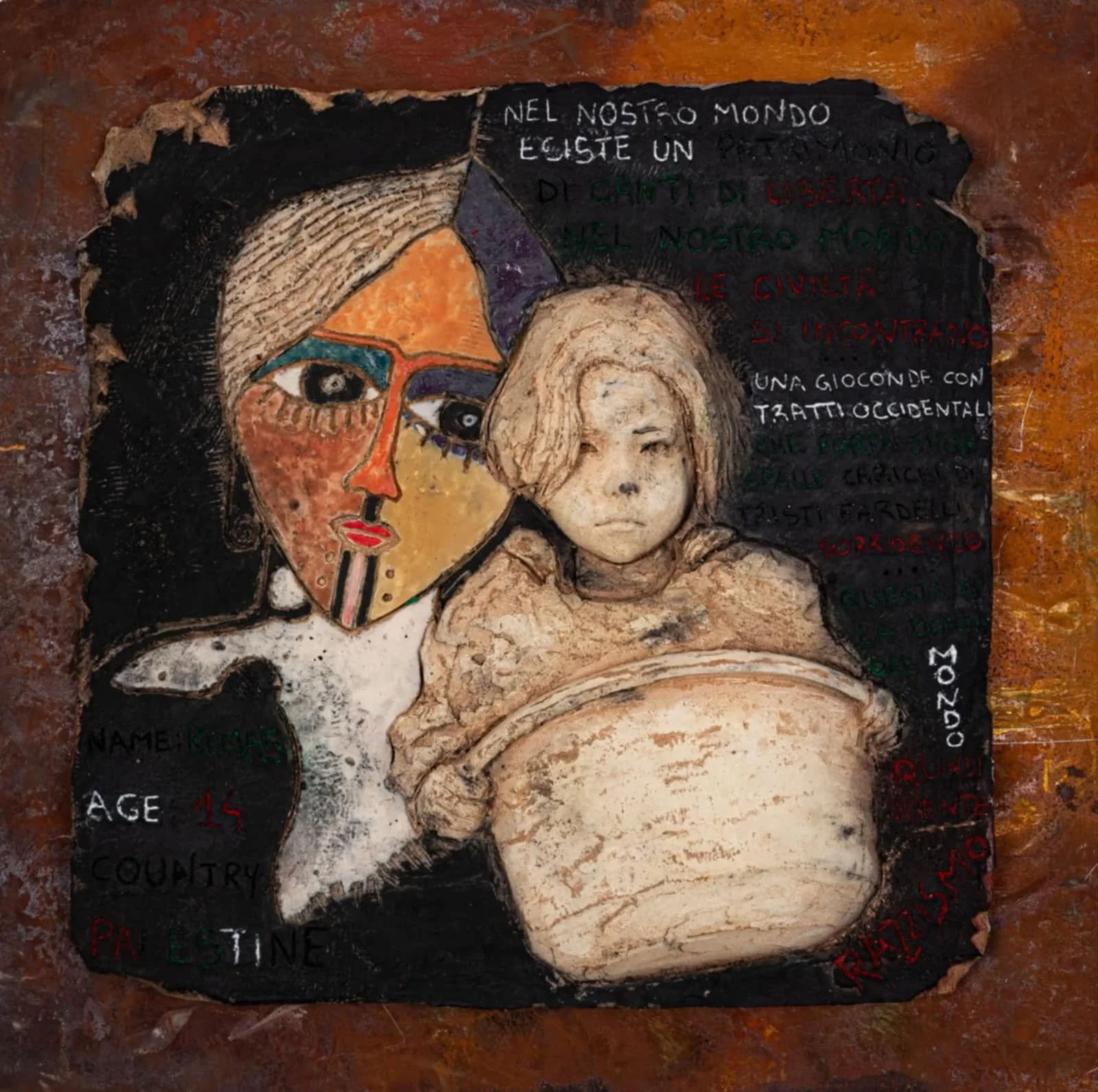
Poem into visual art. This ceramic sculpture by Italian artist Elena Buran was inspired by a poem by Remas Mohamed Zouraba in ‘Moon tell me truth’
These are just a few ideas, showing things that have already been done. You’re very welcome to use one of these ideas of course, but, as we’ve said already, the list is not exhaustative, as we know that your creativity is infinite. We’re sure that you’ll find lots of interesting ways to respond to these incredible poems.
The very best of luck to you all. We very much look forward to seeing what you come up with!