Learning as a slowing down of experience
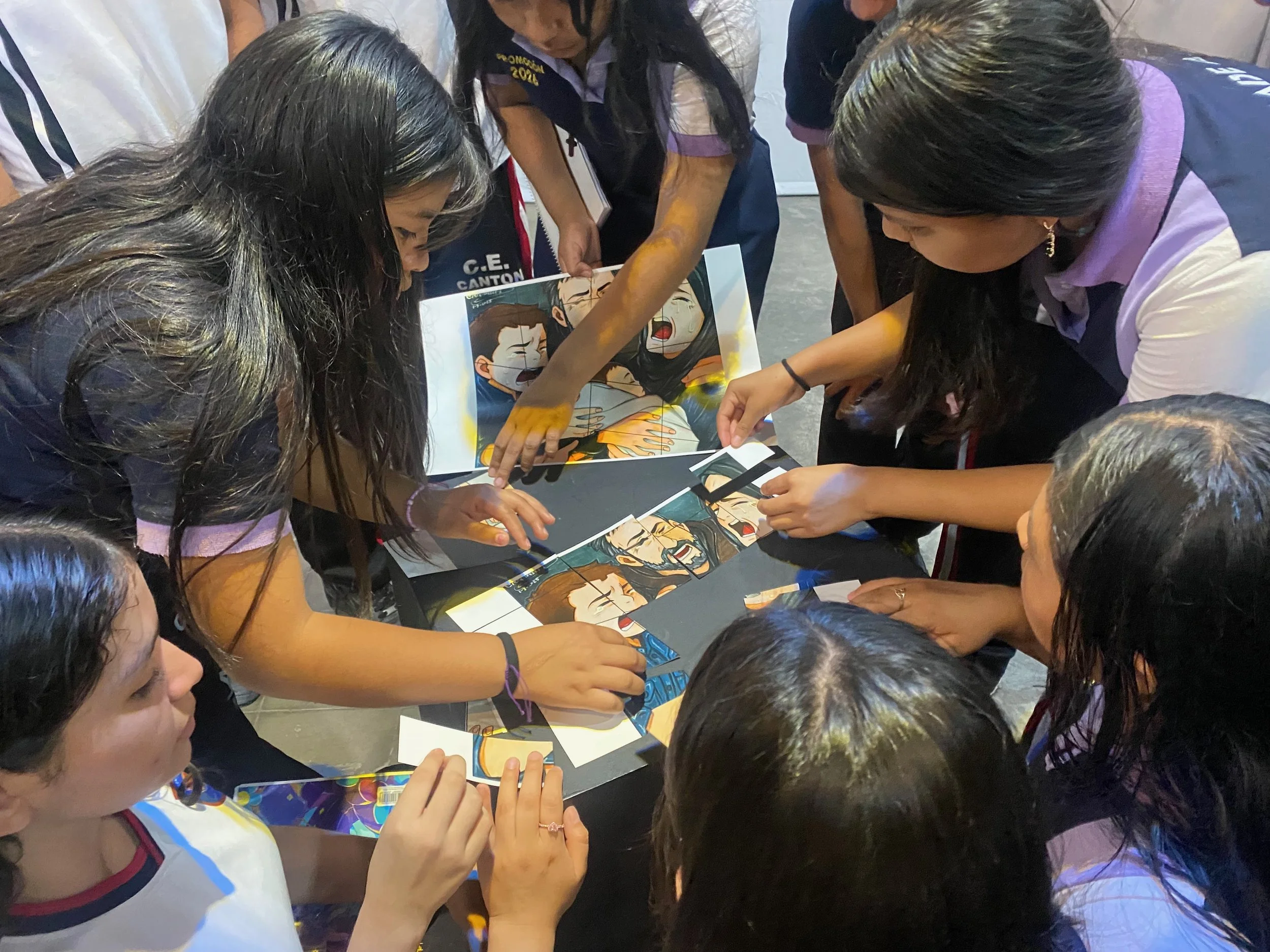
Teenagers in El Salvador reconstructing an image from Yara Abu Kweik’s manga book ‘Shattered’
We can’t deny the fact that AI has had a huge impact on second language education in recent years. But I, for one, am deeply concerned that the impact that it’s had has, in many cases, been more negative than positive.
Real learning isn’t quick. It isn’t easy. It isn’t linear. It involves failure and triumph, laughter and sometimes pain.
An example: I can’t say that if I use AI to write a text in the language that I’m learning that every word in that text has now been learnt by me. Of course I can’t. But strangely many language education systems that I have experience of around the world seem to think that this is what learning is.
Real learning is messy. It’s awkward. It’s a challenge (often a beautiful one) It’s about getting to know words slowly, finding out more and more about them gradually, and eventually maybe eventually learning to love them. It involves feelings; sometimes of self-consciousness and sometimes of pride.
Above all it involves thinking. And generally AI doesn’t involve thinking at all - not of any depth at any rate.
I’m proud to say that a lot of what we encourage in Hands up does involves thinking, and what the late great Dorothy Heathcote (one of my all time heroes in the field of education) referred to as ‘a slowing down of experience’ and ‘a man in a mess’
She was actually referring to drama as a tool for learning when she made those comments, but actually (and I hope Dorothy would forgive me for this) I’d like to suggest that they could also apply to learning in general.
Here are a few examples of this ‘slowing down of experience’ from our work. As you read them think about examples from your own practise as a teacher, or experiences as a learner. We’d love to get some comments from you below.
1) Doing a jigsaw. In the picture above you can see a group of teenage girls here in El Salvador. They were taking part in an activity at the Teatro Solar in Cojutepeque which was the idea of the directors there - Jenny and Juan. They’d divided the kids up into groups of about 8 and each group had one of the images from Yara Abu Kweik’s Shattered., cut up into pieces like a jigsaw. They worked together to reconstruct the image, and, once they’d done that, discussed any feelings that came up for them. I’m sure that the process of trying to reconstruct the image pushed them to think more deeply about the situation in Gaza. The discussion which followed was certainly richer than I’d expected it to be.
2) Creating a piece of art. The embroidered picture below is just one of many pieces sewn by children here in El Salvador to mark the massacres and other atrocities which occurred during the civil war of the 1980’s. This is the ultimate ‘slowing down of experience’ activity. Just think how much planning is involved and how much time it takes to sew a single figure of a person holding a gun.
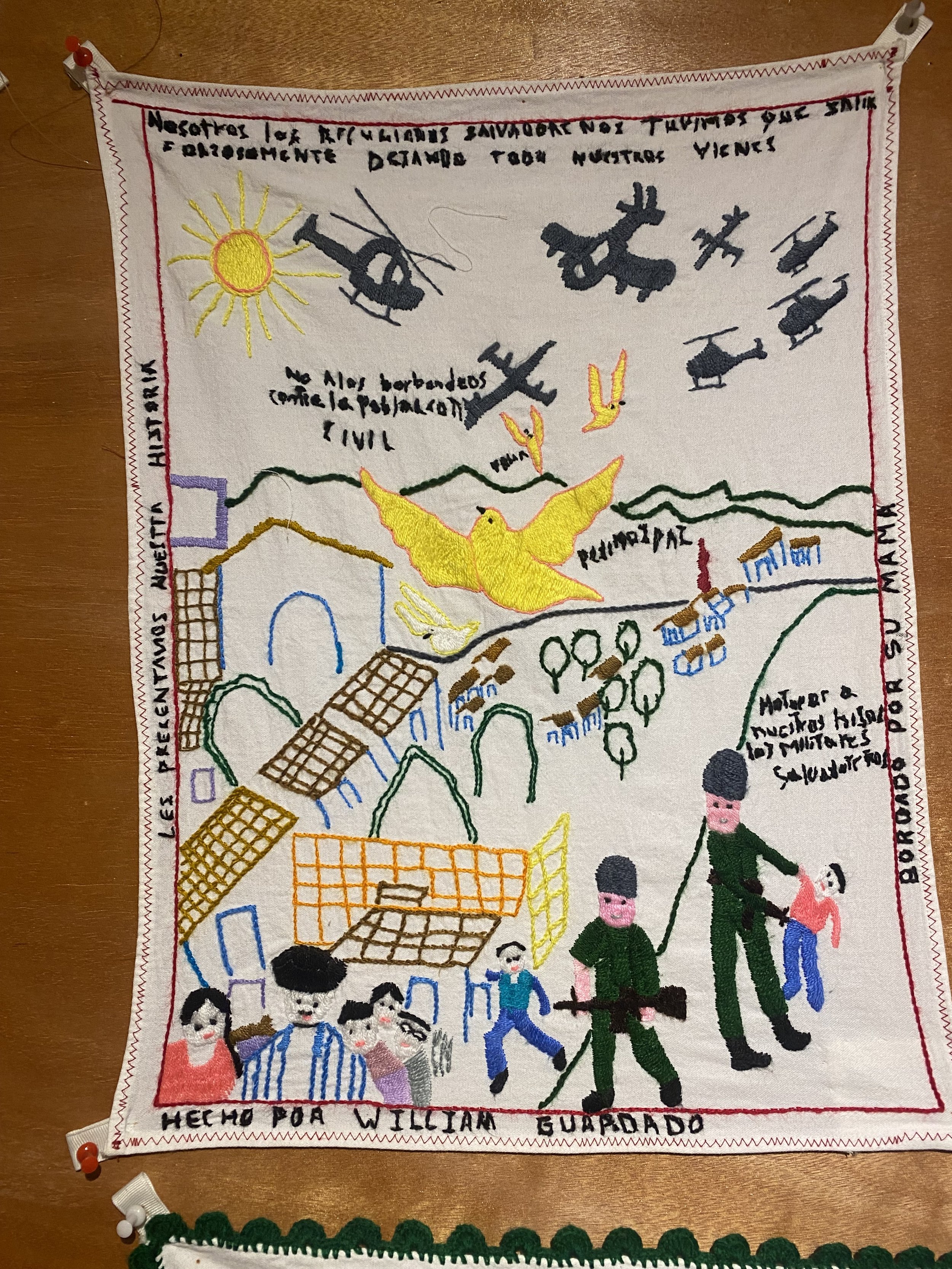
Embroidered artwork by El Salvadorian children
3) Reading a poem in two languages. In the picture below you can see a young girl in El Salvador, reading a poem from Luna Dime la verdad, written in English by 9 year old Fatema in Gaza, with a translation in Spanish underneath.
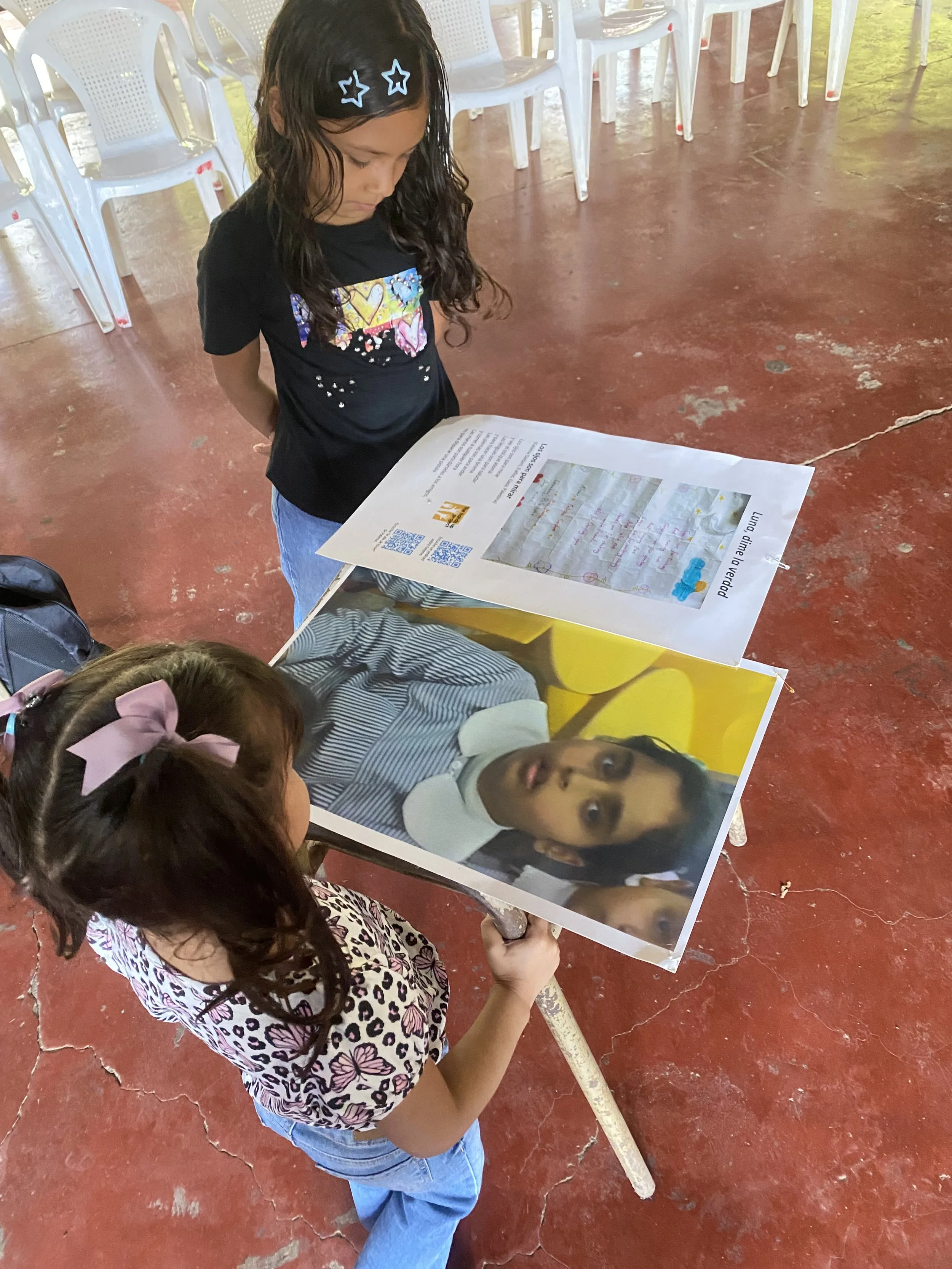
Reading Fatema’s poem
Writing a letter to a poet As I’m sure you know, Fatema was one of the first of our children to be killed in Gaza during the genocide. In a primary school here in El Salvador we read some of the poems to the children, and they all wrote responses in Spanish to the childen. Here’s one that was written to Fatema.
The translation into English is something like this:-
‘Hello Fatema, Today I read your poem. I loved it. It’s very good. I know that you lived in Gaza. Your poem was my favourite and it’s true that hands are for shaking with friends, not for shooting guns. If children were in charge the world would be different. I hope that the war finishes soon’
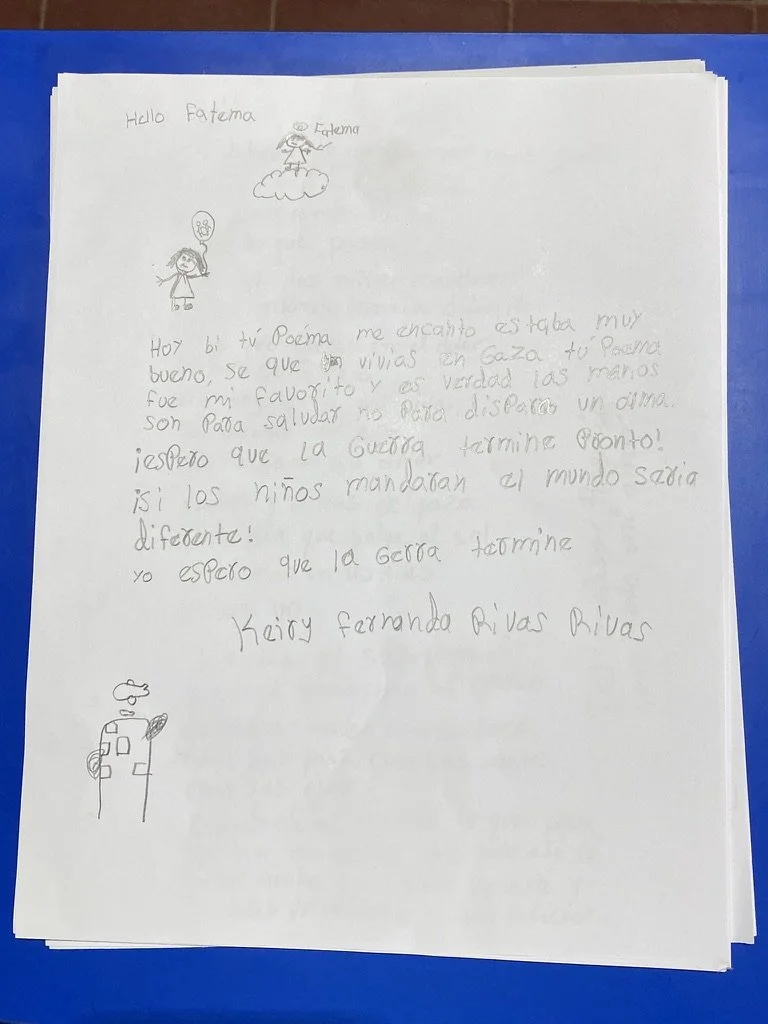
Letter to Fatema
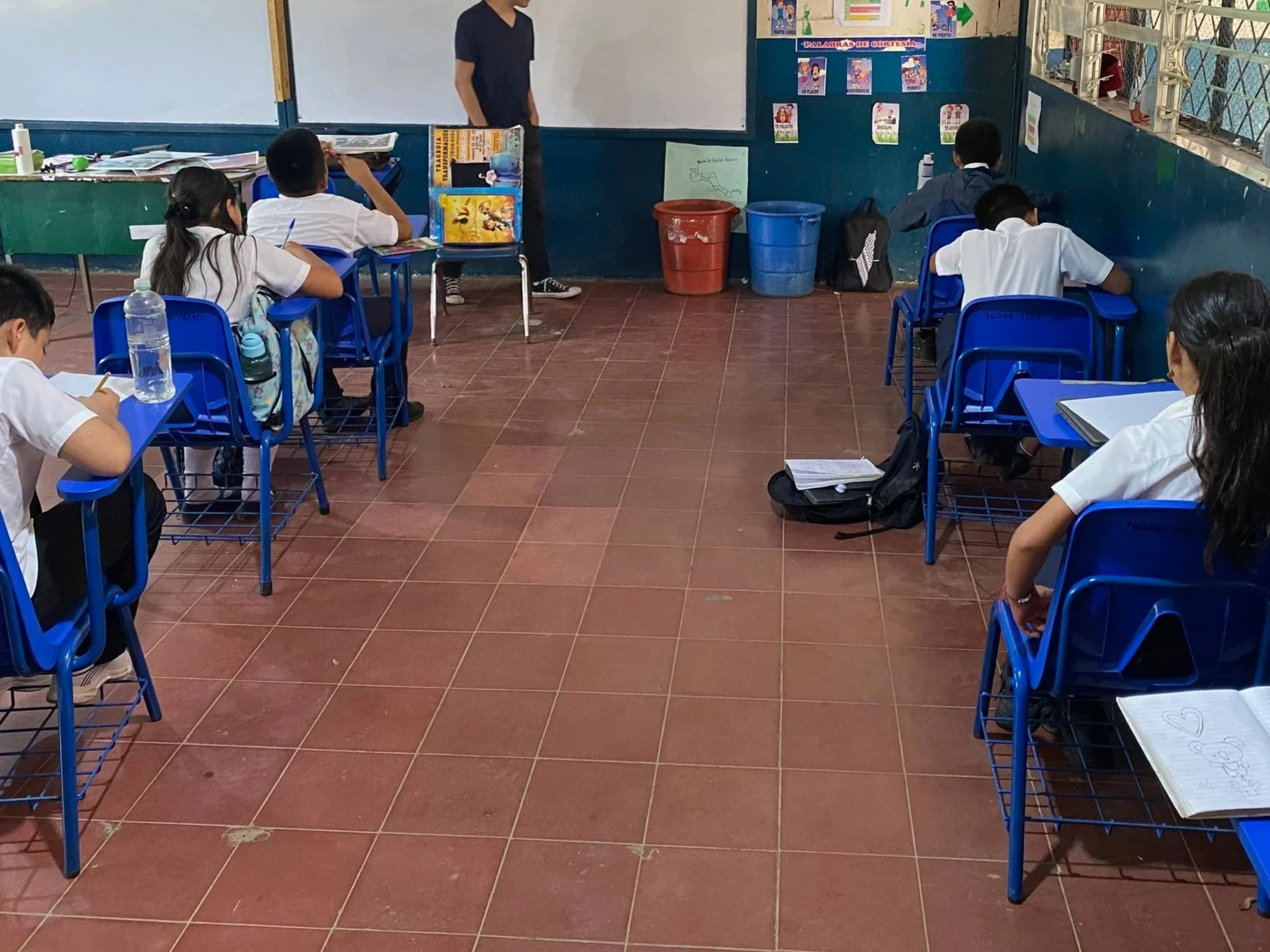
Children from El Salvador planning and writing their letters to the children of Gaza.
And to end with here’s an example from an old HUP activity which is still at the heart of our work.
1) Interacting with a more advanced speaker. When a child in Gaza comes up to the webcam and talks to a person in another country via Zoom, they’re often working at the very limits of their ability. I’ve discussed the video below many times before but want to share it again with this point in mind. Watch how much Bader is struggling to talk about his grandad in English, and struggling to understand what I’m saying to him. Notice too how much pride he feels when he actually manages to express some ideas in English. He later told us that this was the first time he’d ever done this in his life! Such a different learning experience than how it would have been if he’d simply read out a text that he’d used AI to create.
(This session happened almost 4 years ago. We have no idea whether Bader is still alive or not, or has joined his grandfather in Jannah. We pray with all our hearts that he lives)