Look up and speak to the world!
For more than 10 years now, The Hands up Project has been inviting young Palestinians to present themselves through Zoom to other young people around the world, and to our team of volunteers in multiple countries.
This might be through plays and stories and poems that the children perform, or it could be through introducing themselves, or talking about Palestinian culture and history.
Sometimes this works very well and the children manage to connect deeply to the people who are listening at the other end of zoom, and sometimes it doesn’t. In this post I want to focus on a few very simple things that can be done to make the connection work as well as possible.
By way of example have a look at the video below of 10 year old, Elham, performing a beautiful poem that she wrote for World Peace day, to a class of children in Spain.
Here’s the poem - in Arabic and English.
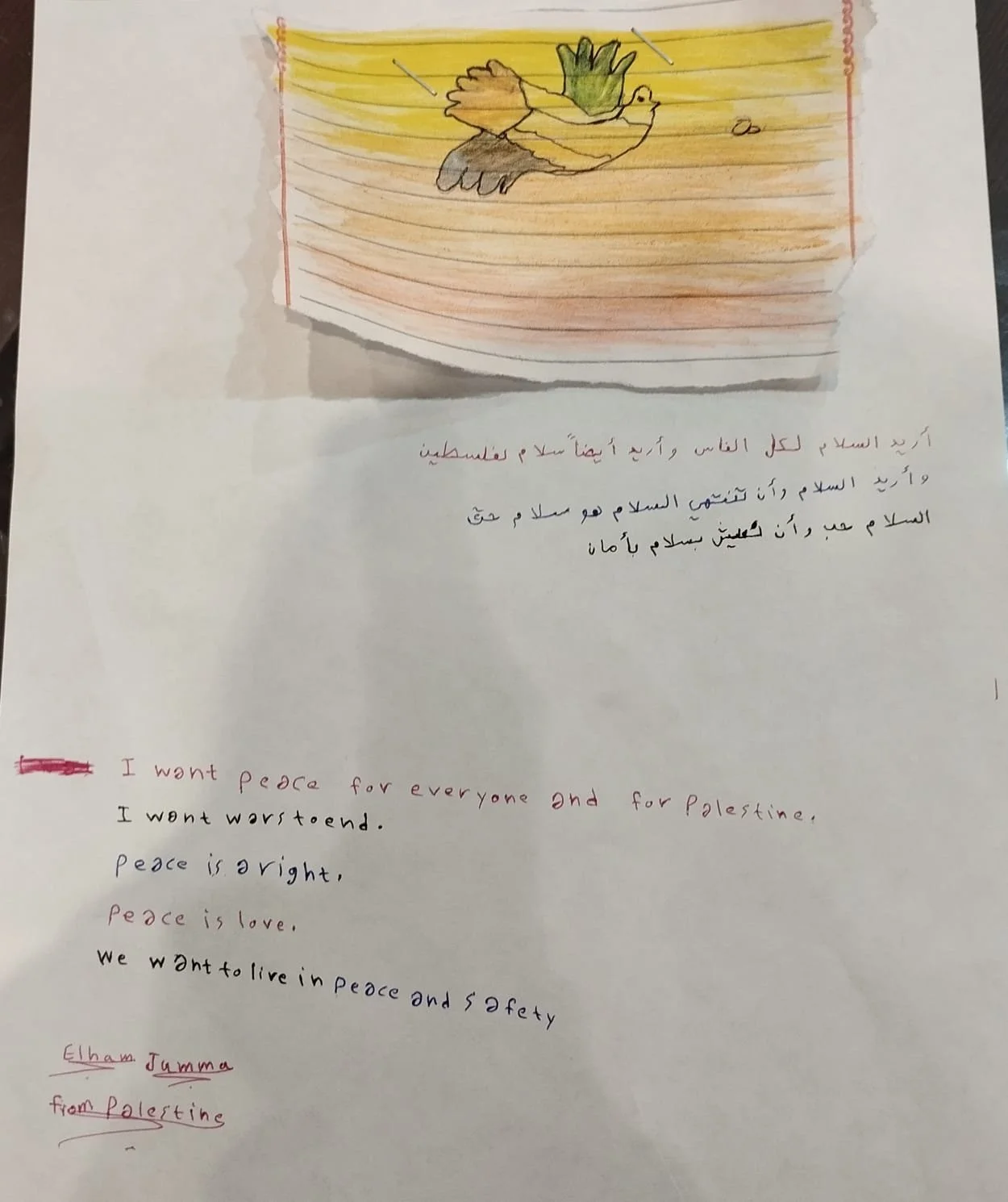
Watch the video below of Elham performing her poem and think about how effective it is? Do you feel that Elham is connecting to you as the audience?
Here are some points that I notice when I watch it..
1) It’s great that the text uses very simple words which Elham undertands. Speakers fail to connect to the audience when they use long complex words, which they don’t understand themselves.
2) Elham looks down to read her text and up at the audience when she speaks. This means that the audience feel that she is directly speaking to them. It also means that she engages her working memory, which is very important in terms of speaking fluently. In my opinion it’s not necessary for the children to memorise the text completely at this stage. This can be unnecessarily stressful and lead to fossiliation of inaccurate pausing and pronunciation.
3) Elham generally ‘chunks’ the text well. She looks down to read and retain in working memory ‘I want peace for eveyone’, then looks up to say it. She then repeats this with ‘for everyone’. There is a natural pause between these two chunks and it makes sense entirely that Elham pauses here. It doesn’t work quite so well in the next sentence when Elham pauses after ‘wars’ in ‘I want wars to end’, becasue this is an unnatural pause, making it harder for the audience to follow.
I think a very useful thing for language learners to do when they they have prepared texts to perform is to go through them and to decide where they think the pauses should be. These are the points where they should look down. They can then practice doing it in this way.
4) Because she’s looking up to speak, Elham makes eye contact a lot. This is one of the most powerful ways we have of connecting to an audience.
5) It’s great when Ilham uses simple gestures - for example hugging herself on the word ‘safety’. I think the performance could be improved by incorporating a few more gestures.
6) We communicate so much through our faces, and in zoom sessions there’s the potential for the audience to see our faces even more clearly than in a face to face class. In my opinion the performance would work eevn better if Elham was closer to the camera.
How about you - teachers around the world? Is there anything else that you notice about the perfomance of Elham’s poem? We’d love to know if you can try out this technique with the children you teach in your context? Please write a comment below.