When gun is an uncountable noun
As teachers one way we can look at grammar in our classrooms is as a series of rules to be obeyed at all costs by the students;
‘You mustn’t split infintives!’ ‘Never end a sentence with a preposition!’ ‘Don’t forget the third person s’ etc.
I think this is quite a common approach used by teachers around the world, but it’s also one which is flawed. For a start, it places too much unnecessary power in the hands of the teacher and ignores the learners’ own developing grammatical awareness. Now I’m not against correction or explicit teaching of rules. Far from it. I think there is so much evidence that shows that focussing on language issues in a classroom setting can help learners to notice patterns in the real world (see for instance Schmidt and Frota 1986). But we ‘d be foolish to assume that this technique will have an immediate impact on the language that students produce. People will learn things when they are ready to learn them; when they can fit new language into their own internal, and largely subconscious, developing grammatical awareness; not when we point out that they are wrong.
Secondly, it’s important to consider whether we’re advocating a prescriptive view of grammar (what we think people should say and write ) or a descriptive view (what people actually say and write). It’s quite common for writers to subconsiously split infinitives and end sentences with prepositions, without it being something to be concerned about. (You’ll have noticed that I’ve just done both these things myself. Hope it wasn’t too painful for you!).
Prescriptive rules are broken in speech by advanced and native speakers of English all the time. The other day a Palestinian English teacher friend of mine pointed this out to me when I was clearing the table for dinner, and I said ‘There’s some books on the table. Where should I put them?’ Why did I make this ‘mistake’? It’s obviously not because I don’t know the rule that there are is used for plural countable nouns, and there is is used for uncountable nouns. I think it’s because I was seeing the books as a single entity, and their (or shoud I say its ) existence mattered more to me than the fact that there were several of them. So was I making a mistake, or was I just expressing a different meaning?
And this brings us to the third problem. Merely correcting the mistake (ie focussing entirely on language form) leaves no room for discussion of the meaning carried by the utterance which was deemed to be incorrect.
With some utterances there will be no difference in meaning. An example of this is the third person s rule. In English personal pronouns are almost always used with the verb to carry the meaning of who is doing the action.
She lives in Cuba. I live in Cuba, etc.
Contrast this with Spanish for example where prounouns may be omitted and the meaning is carried by the verb form
Vive en Cuba. Vivo en Cuba. etc
So ‘She live in Cuba’ can only really be understood in one way, and has no difference in perceived meaning from ‘She lives in Cuba’. For this reason it is notoriously difficult to learn to use the third person s form. Although it’s generally focussed on in beginner level coursebooks, it is often fully acquired only at advanced levels, and sometimes never at all.
Contrast this with something like the passive voice, where choosing to use it or not will usually imply a clearly different meaning to the listener. I’m reminded of an activity by the late, great Mario Rinvolucri and Paul Davis in their brilliant book ‘More Grammar Games’ (CUP 1995)
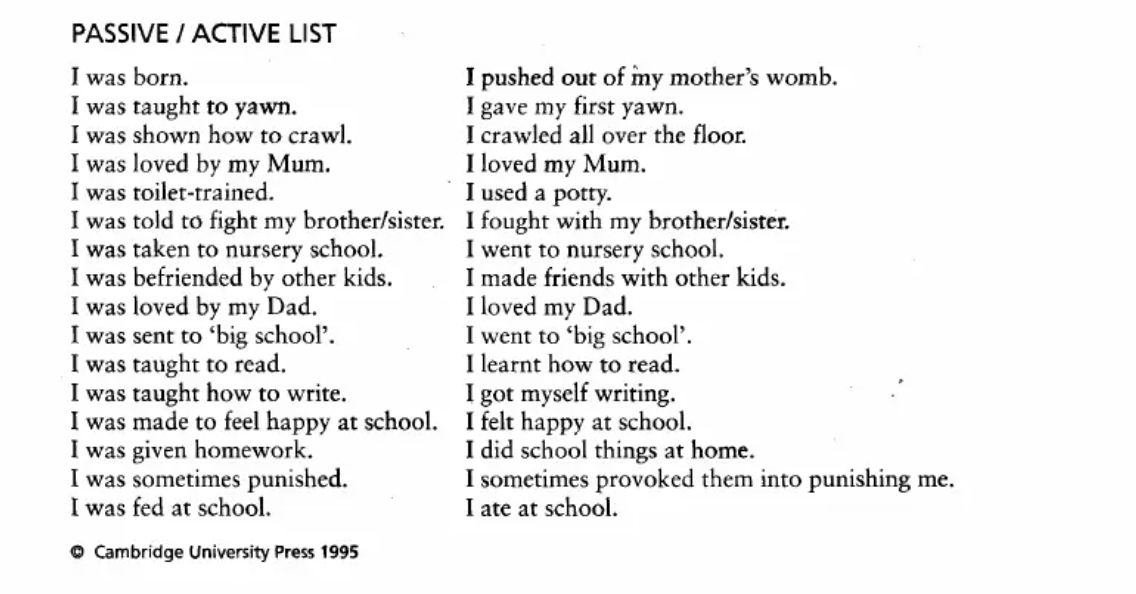
Students are invited to go through the two columns of sentences and choose ones which they feel personally apply to them. After discussing. their choices in groups they then go on to do the following tasks, encouraging them to produce their own examples. I’ve used this exercise with so many different groups of learners over the years and can think of no better way of raising awareness about the meaning of the passive voice.
Now let’s take an example from our work in the Hands up Project. In the Spring of 2023 Fatema Saidam (below aged 9) hand wrote this poem and it was later published in our first poetry collection ‘Moon tell me truth’ (HUP 2023).
Eyes are for looking and seeing sun
Tongues are for greeting and saying fun
Legs are for walking slowly and also run
Hands are for shaking with friends
Not for shooting gun

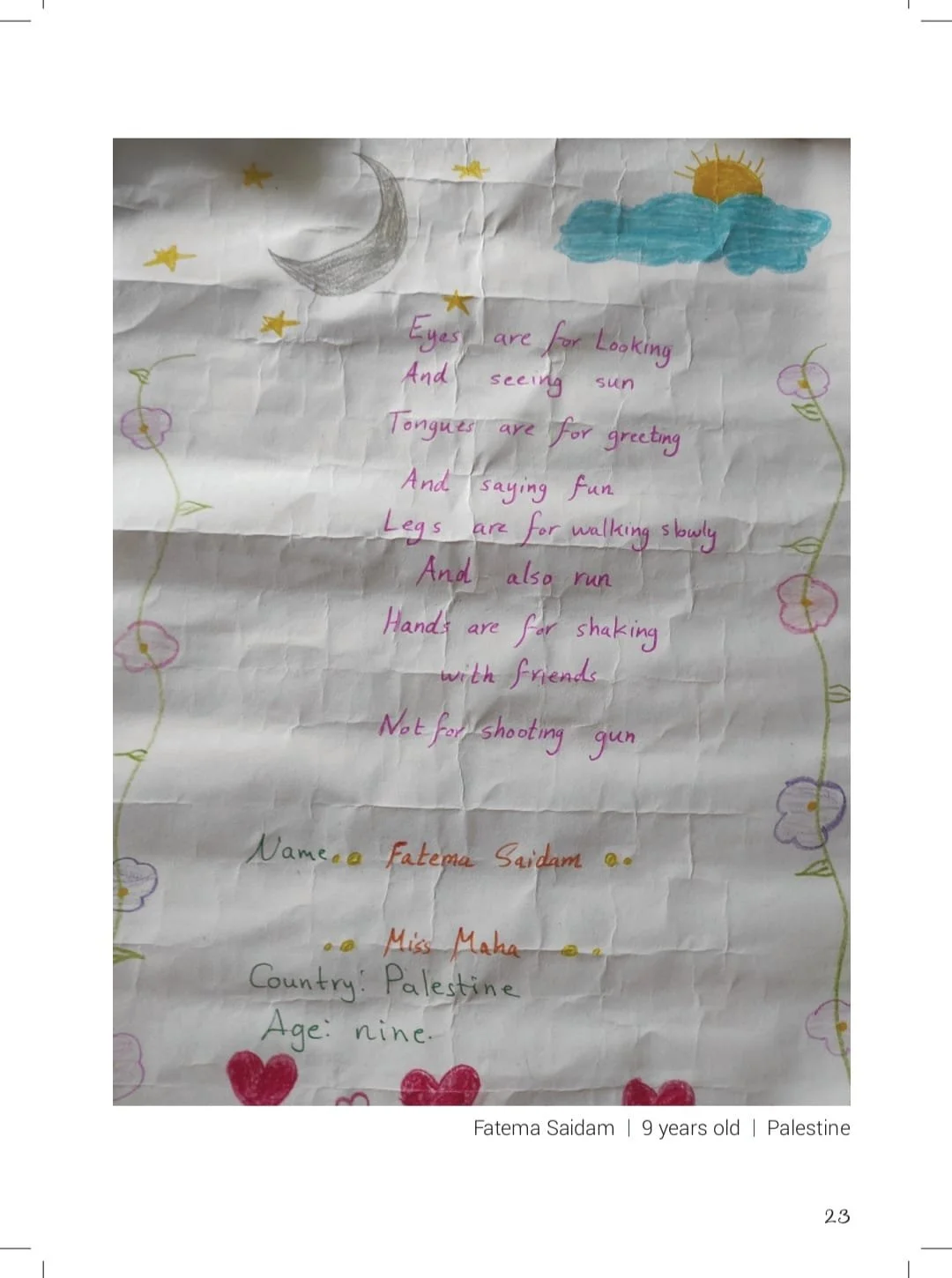
It’s a remarkable poem with words of wisdom for the whole world to learn from. It’s also a piece of writing which contains grammatical ‘mistakes’ which some teachers might want to correct. In my opinion this would greatly diminsh the poem’s impact. Another approach might be to simply accept the meaning implied by the grammar.
You’ll notice that Fatema uses a word which is normally seen as a countable noun (gun) with the grammar normally used with uncountable nouns (no indefinite article and no plural form) Why might she have done this?
Perhaps she is directly translating from her mother tongue, Arabic, where there is no indefinite article, or perhaps she’s doing it to rhyme with the words sun and fun that she used at the ends of previous lines.
The tragedy is that nobody will ever be able to talk to Fatema about this, or indeed about anything else, because Fatema was killed with her entire family in an Israeli airstrike on her home on the 18th October 2023.
We’ll never really know what led Fatema to write ‘Not for shooting gun’ instead of ‘Not for shooting guns’. But we do know that we’re glad that she did, because this is poetry, and, like all good poetry, it uses language in original ways to help us understand something about the world. More specifically it helps us to understand the world of the children of Gaza who, to the colossal shame of the rich and powerful nations, have lived their entire lives with gun as an uncountable noun.

Gun as an uncountable noun
References and further reading
Davis, P and Rinvolucri, M (1995) More Grammar Games; Cambridge University Press
Norrington-Davies, D, From Rules to Reasons: Practical Ideas and Advice for Working with Grammar in the Classroom; Pavillion 2016
Schmidt, R., & Frota, S. (1986). Developing basic conversational ability in a second language: A case study of an adult learner. In R. Day (Ed.), Talking to learn: Conversation in second language acquisition (pp. 237-369). Rowley, MA: Newbury House.
Various young poets ‘Moon tell me truth’ (HUP 2023)