Make your own game for language learning
More than twenty years ago, when my kids were still very young, we got a visit from some old friends of mine from Denmark. They brought a memory game with them as a gift for my family. The game was called Hønsefræs (in Danish) and it became one of the most popular games in my family for many years.
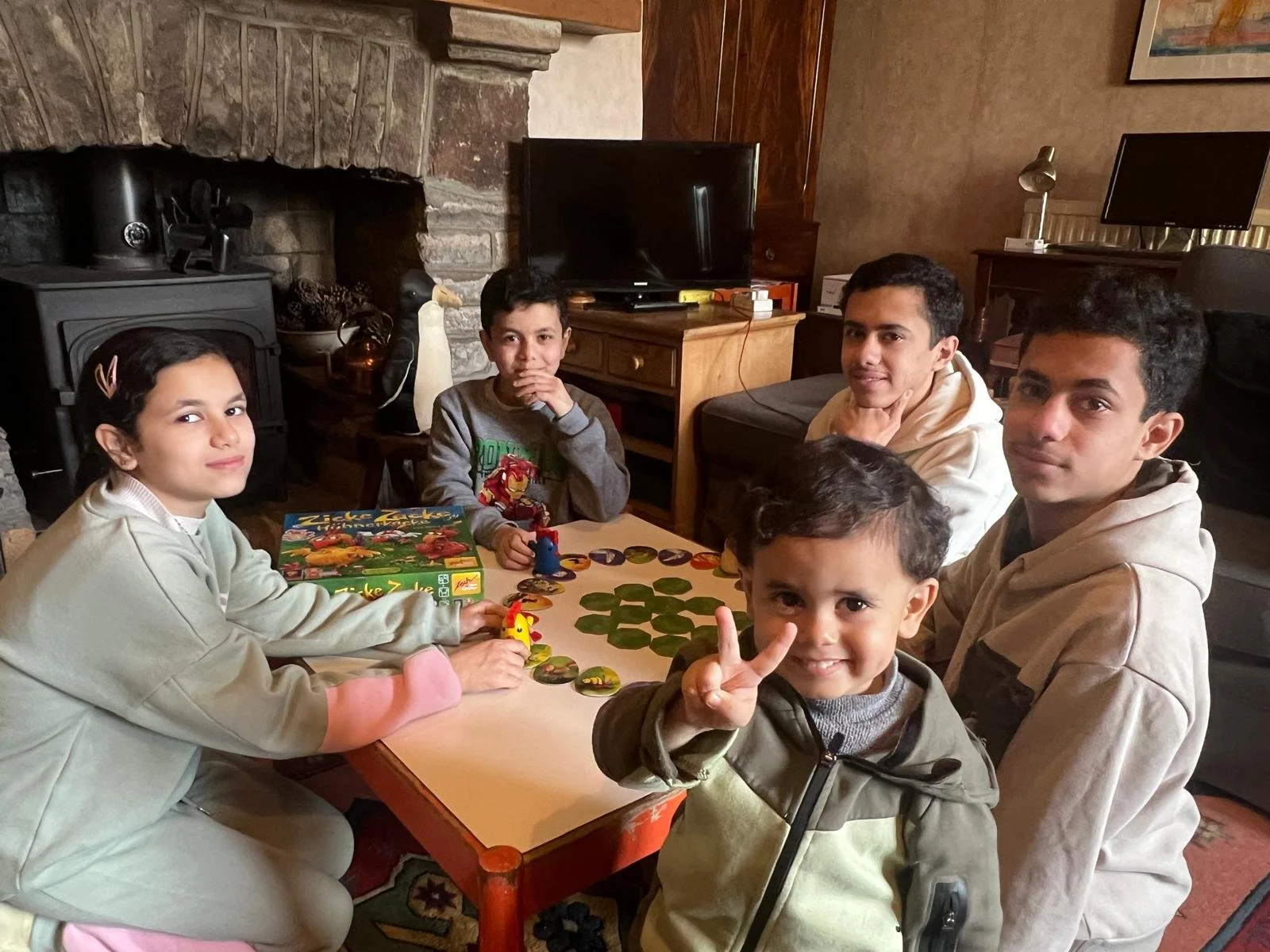
When my friend and colleague from Gaza, Ashraf arrived recently in the UK I bought him the game because i thought his kids might enjoy playing it. Here’s a picture of them recently playing the game ( I had to order it from Germany since it doesn’t appear to be sold in the UK)
The game is quite compelling and could be used for language learning - certainly for practice of some basic vocabulary items. But being an obsessive language teacher who never switches off ;-) , I was always trying to think of a way to use this game as an activity to develop and practise language in a more systematic way. By the time I wrote ‘Memory activities for Language Learning’ in 2011, I’d found a way to do it. Here’s an extract from the book, outlining how I suggested using the game to practice and learn which suffix to use in converting verbs to nouns.
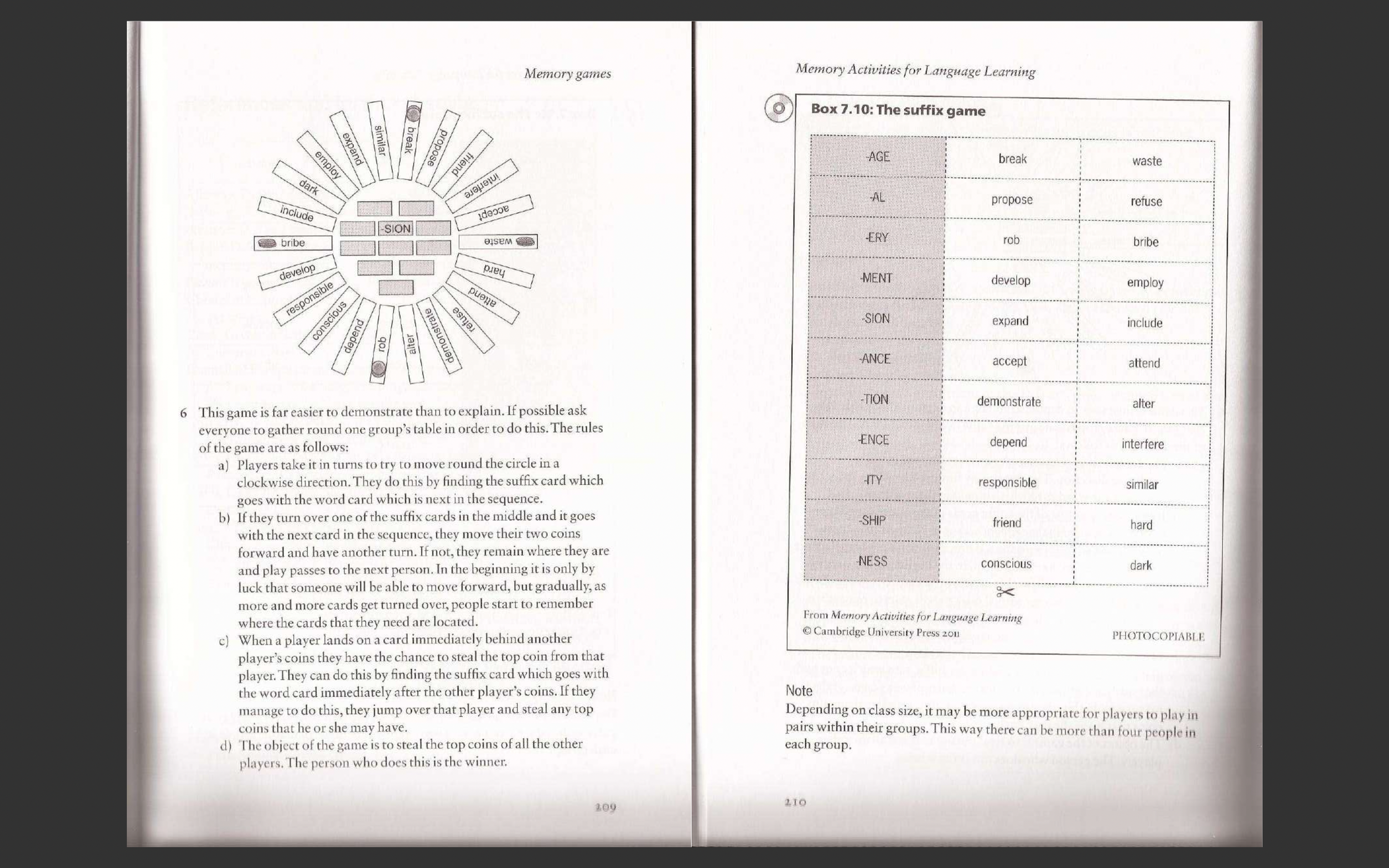
From ‘Memory activities for Language Learning’ Bilbrough 2011 (Cambridge University Press)
But that’s for quite high level learners who are interested in improving their vocabulary. How about using the game for much younger children like some of those in our educational space in Cairo?
Here’s how we did it… First I asked the kids to do some simple pictures on squares of paper for 12 things that could be drawn easily, and which were quite high frequency (we had things like table, cup, tv, cat, book etc), and placed them face down in the middle of the table. Then we wrote each word twice and placed them around the cards in the middle as a circle.
In this video you can see some of the kids, and some of the teachers playing the game together. (If you haven’t read the long intructions above, the game, in a nutshell, is about trying to remember where the picture is that represents the written words in the circle)
Here are some of the areas of language which get focussed on in this game…
Obviously there are the written and, to a lesser extent, the spoken forms, of the words in the game. Because there’s so much repetitition of these items, it’s highly likely that all the learners will, by the end of the game, know the spellings and the pronuciation of all of these words.
Less obviously, there’s all the language that the students get exposed to because of playing the game. This might include useful and high frequency language like - Where is the X?, Oh it’s the Y, Your turn!, My turn?, You can’t remember?, What do you need? That’s what you need! etc) Again because these phrases are nicely contextualised, and because they get repeated so many times during the course of the game, there’s a good chance that they will be very easily understood by everyone by the end.
So over to you, now.
Could you use this game for the learners you work with? What other games have you used for language learning purposes? Have you ever created a game to play with your learners.? Please write a comment below.