When Big Words Get in the Way (and How Simpler English Can Help)
By Our Volunteer & Learning Coordinator, Safa Ahmed
The Challenge Behind the Impressive Vocabulary
One challenge that many of our volunteers have noticed across Hands Up projects is learners' tendency to use what we sometimes call "big words".
Whether students are preparing a presentation for Bridges to Gaza, writing a story, sharing a poem, or participating in one of our storytelling events, they often arrive with impressive pieces of work filled with advanced vocabulary and sophisticated expressions. This is understandable. Many learners believe that strong English means difficult English, and they naturally want to challenge themselves and impress their audience.
Increasingly, learners also have access to AI tools that can instantly generate polished paragraphs, presentations, and stories. While these tools can be incredibly helpful, they sometimes produce language that is far beyond a learner's current level. As a result, students may end up presenting words they have never heard spoken aloud and cannot confidently explain themselves.
Sometimes, however, these ambitious choices create new challenges.
When Pronunciation Becomes a Barrier
In one of our recent Bridges to Gaza sessions, students were asked to prepare short presentations on a topic of their choice. Since the session took place just two days before Eid Al-Adha, several students chose to talk about what the occasion means for Muslims.
One student had clearly prepared carefully and included vocabulary that sounded impressive on paper. However, when presenting, she struggled with words such as calendar and sacrifice, pronouncing the /k/ sound as /s/, and slaughter, a word made particularly difficult by English spelling patterns and silent letters.
Neither of these mistakes is unusual. In fact, they reflect two of the most common challenges English learners face: the different pronunciations of the letter "c" and the many silent letters found in English words. If learners encounter unfamiliar vocabulary only through reading—or through AI-generated texts that they have not fully understood or rehearsed—they can easily fall into this trap.
Exactly that happened with our learner.
The result is that students often spend more energy trying to remember and pronounce difficult words than communicating their ideas.
When Communication Gets Lost
In projects focused on storytelling and public speaking, this challenge goes beyond pronunciation.
When speakers rely heavily on unfamiliar vocabulary, they often become less confident. Their attention shifts from sharing a message to remembering words. Listeners, meanwhile, may struggle to follow the presentation and can become less engaged.
This is especially important in storytelling, where connection matters more than complexity.
A presentation can be grammatically perfect and full of advanced vocabulary, yet still fail to communicate its message. On the other hand, a simple story told clearly and confidently can leave a lasting impression on its audience.
When Simpler Language Creates a Stronger Story
We saw a wonderful example of this during one of our recent storytelling events.
One student, Lama, arrived with a beautifully written story containing sophisticated expressions and complex sentences. The writing itself was impressive, but some of the language felt distant from the way she naturally spoke.
During rehearsals, her volunteer worked with her to simplify parts of the text and replace unfamiliar expressions with language she felt comfortable using.
Something interesting happened.
As the language became simpler, the story became stronger.
Once Lama stopped worrying about unfamiliar vocabulary, she was able to focus on what really mattered: telling the story. Her storytelling flowed more naturally, her personality came through more clearly, and the audience connected more deeply with her message.
The story itself did not become less powerful. Quite the opposite happened.

Photo: Part of Lama's original story before it was adapted and simplified during rehearsals.
If you'd like to see how Lama transformed this story into an engaging performance even while battling a weak internet connection, you can watch her storytelling here: https://youtu.be/4gs5wOCbaFc
What We're Learning Through Public Speaking
This lesson has shaped the way we approach our Public Speaking Course.
One of the course's aims is not simply to teach learners how to stand in front of an audience. We also want them to learn how to communicate effectively using language that feels authentic to them.
Students explore how to organise ideas, engage listeners, use body language, vary their voice, and build confidence. An important part of that journey is learning to ask a simple question:
How can I help my audience understand and remember what I want to say?
This shift in thinking often transforms learners' presentations.
After all, audiences rarely remember the most difficult word in a presentation.
They remember the message.
Teachers Need Simple Language Too
Interestingly, this principle applies not only to learners but also to teachers.
Recently, we held a workshop for Hands Up volunteers focused on grading teacher language. Together, we explored practical ways of adapting instructions, explanations, and classroom language to match learners' different levels of English.
The discussion highlighted how meaning can often be communicated more effectively through simple language, modelling, gestures, drawings, demonstrations, and visual support than through lengthy explanations.
When teachers simplify their language, they are not lowering expectations. They are making learning more accessible.
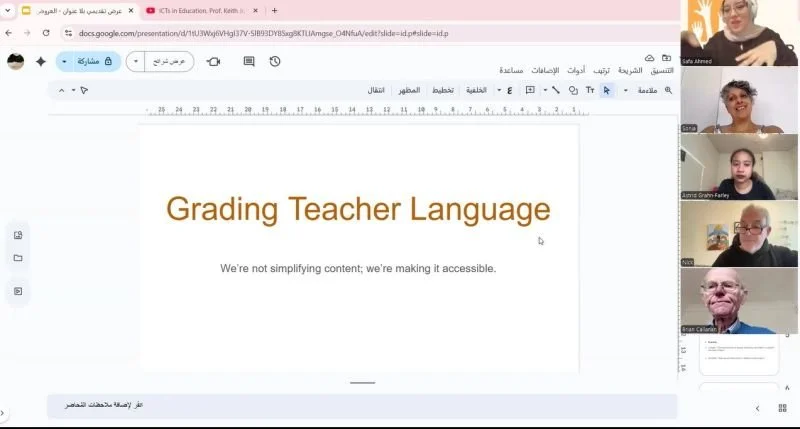
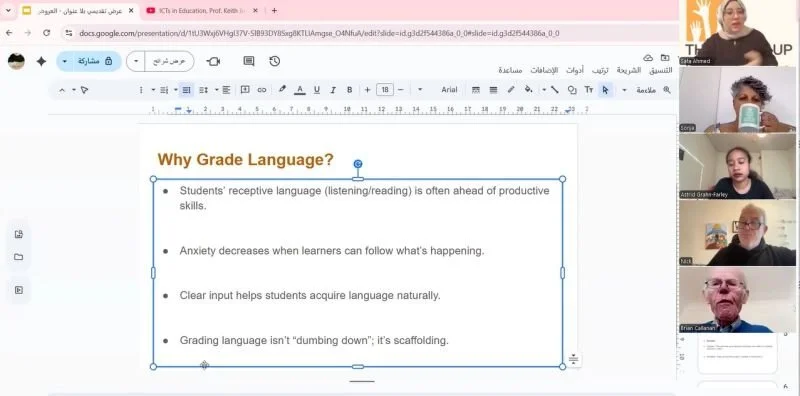
Photo: Volunteers participating in a workshop on grading teacher language to better support learners at different levels of English
What Can Volunteers Do?
These experiences have influenced not only our programmes but also the practical advice we share with volunteers.
Encourage learners to explain difficult words
If a learner uses an advanced word, try asking:
"Can you explain that in your own words?"
If they can explain it confidently, wonderful. If not, it may be a sign that simpler language would help them communicate more effectively.
Prioritise meaning over sophistication
Learners sometimes assume that difficult vocabulary automatically sounds better. Reminding them that communication is the goal can be incredibly helpful.
Celebrate clarity
When giving feedback, praise students for communicating ideas clearly and engaging their audience—not only for using advanced vocabulary.
Model simple language yourself
One of the most effective ways to teach clear communication is to demonstrate it.
When volunteers use language that is accessible and easy to follow, learners begin to realise that effective communication does not require complicated vocabulary.
Helping Learners Find Their Own Voice
At Hands Up, we do not want learners to avoid ambitious vocabulary or stop challenging themselves. Expanding language is an important part of learning English.
What we hope, however, is that learners gradually develop the confidence to use language they truly understand and can make their own.
Over the years, we have seen learners write poetry, perform plays, tell stories, lead presentations, and speak to audiences across the world. The moments that stay with us are rarely the most linguistically sophisticated ones. They are the moments when learners speak with confidence, authenticity, and a genuine desire to connect with others.
In a world where AI can generate increasingly sophisticated language at the click of a button, helping learners discover and trust their own voice may be more important than ever.
Because ultimately, language is not about sounding impressive. It is about making a connection.
And our goal is not to help learners sound like somebody else.
It is to help them discover that their own voice—in whatever English they currently possess—is already worth listening to.